Can Two Obsessions Cancel Each Other Out?
I recently watched a YouTube video by Woman Grandmaster Dina Belenkaya titled The Dark Side of Chess. It seems that some of the greatest chess players in history have also been, shall we say, a little nuts.
This concerned me.
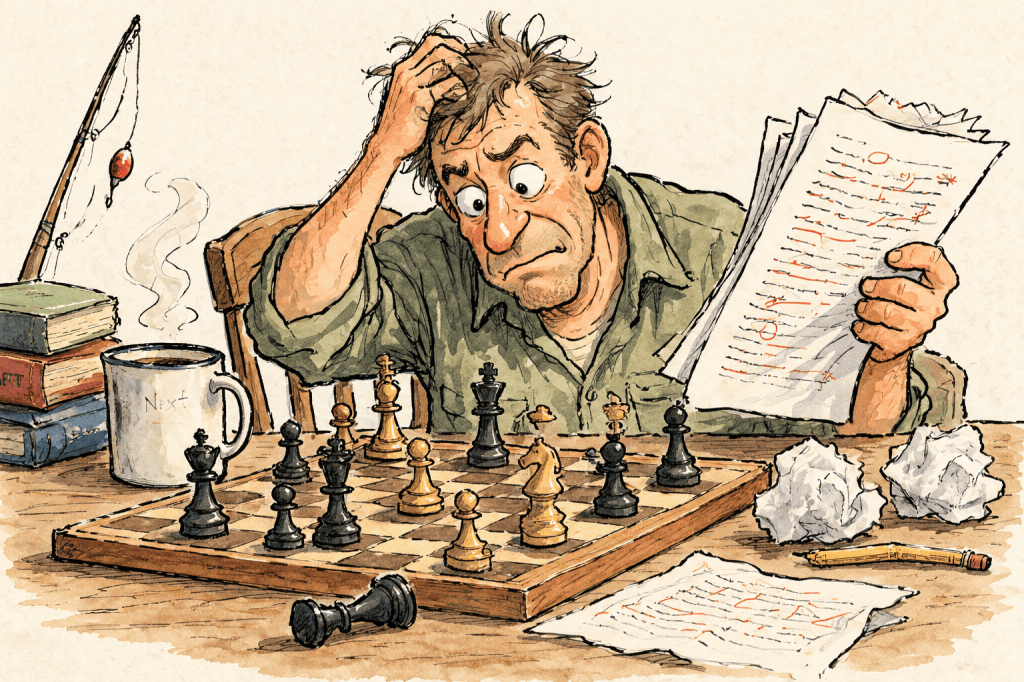
I’ve played chess for years. I enjoy the challenge, the strategy, and the satisfaction of finding a clever move. I’ve also spent an unreasonable amount of time thinking about moves I should have made, moves I shouldn’t have made, and moves I was absolutely certain were brilliant until my opponent demonstrated otherwise.
Apparently, this might be a warning sign.
In the video, Belenkaya explored the psychological toll chess can take on its most devoted players. She discussed obsession, isolation, the pressures placed on childhood prodigies, and the possibility that chess attracts a particular kind of mind. One that simply refuses to shut down.
I began to recognize some troubling similarities.
Fortunately, I have another pursuit that provides a healthy escape from chess.
I write fiction.
Then I started thinking about writers.
Oh, dear.
The Trouble with Chess
Psychologists Daniel Kahneman and Amos Tversky developed a concept called loss aversion. Their research suggests that losing something generally hurts more than gaining the same thing feels good.
In financial terms, losing $100 may sting roughly twice as much as gaining $100 pleases us.
Now consider chess.
You can play ten games, win five, and lose five. By any reasonable accounting, you’ve broken even.
Psychologically, however, you’ve apparently suffered a substantial loss.
You remember the blunder in game three. You replay the missed opportunity in game seven. You lie awake wondering how you overlooked that bishop in game nine.
The five victories? Those were simply evidence that you knew what you were doing.
Then there’s the physical toll.
The video mentioned research suggesting that elite chess players experience elevated heart rates and considerable physical stress during competition. One widely circulated report even claimed a grandmaster could burn more than 500 calories during a two-hour game, comparable to playing tennis.
Subsequent research has cast doubt on those calorie estimates, but the physiological stress is real.
For a moment, though, I thought I’d discovered the perfect exercise program. Sit in a comfortable chair, stare at a board, and watch the pounds melt away.
I was prepared to cancel my gym membership.
Then I remembered I don’t have one.
The Trouble with Writers
Having established that chess might be hazardous to my psychological well-being, I turned to my other passion for reassurance.
Writing.
Consider the typical fiction writer.
We spend hours alone in rooms, inventing people who don’t exist. We give these imaginary people personalities, histories, ambitions, and problems. Then we deliberately make their lives miserable.
Sometimes we kill them.
Sometimes we bring them back.
And we expect people to pay us for the privilege of reading about it.
We hear voices in our heads, conduct imaginary conversations, and become emotionally invested in the welfare of people who have never drawn a breath.
We also spend an extraordinary amount of time arguing with ourselves.
Would this character really say that? Should he enter through the front door? What if she knows something he doesn’t? Would the entire story collapse if I moved this scene three chapters earlier?
I’ve spent hours trying to solve problems that exist entirely because I invented them.
Come to think of it, that sounds remarkably similar to chess.
Chess players study openings. Writers agonize over opening lines.
Chess players sacrifice queens. Writers sacrifice characters.
Chess players spend hours analyzing positions. Writers spend hours analyzing plots.
Chess players stare at a board, wondering what happens next. Writers stare at a blank page, wondering the same thing.
And both occasionally experience the satisfaction of discovering that six hours of concentrated effort have produced absolutely nothing useful.
I’m beginning to see a pattern.
A Scientific Investigation
As someone with an engineering background, I decided this problem deserved a more systematic approach.
I have two intellectually demanding pursuits, each apparently capable of producing obsessive behavior, emotional distress, and prolonged periods of sitting alone while questioning my decisions.
The question is whether combining them makes things better or worse.
I have developed two competing theories.
Theory One: The Additive Effect
Chess and writing reinforce each other’s psychological hazards.
The chess player becomes obsessed with finding the perfect move. The writer becomes obsessed with finding the perfect sentence. Both develop an unhealthy attachment to solving problems that may have no satisfactory solution.
Combine the two, and the result could be catastrophic.
My preliminary mathematical model is:
Where:
- Nₜ = Total nuttiness
- Nᶜᵢ = Nuttiness attributable to the ith chess incident
- Nʷⱼ = Nuttiness attributable to the jth writing incident
- n, m = Number of incidents in each category
- N = One standard accumulated unit of nuttiness, a measurement whose precise definition remains under development
The model assumes each pursuit contributes an equal amount of nuttiness.
Under this theory, I’m twice as likely to go nuts.
Possibly three times, depending on how many novels I’m working on.
Theory Two: The Cancellation Effect
Chess and writing exercise different parts of the mind and somehow balance each other.
Chess operates within a rigid structure. The pieces move according to fixed rules. Every position has consequences, and the game eventually produces a result.
Writing offers freedom. I can invent worlds, change the rules, rearrange events, and decide who lives or dies.
In chess, when I make a terrible decision, I have to live with the consequences.
In fiction, I can rewrite the chapter.
Perhaps the creative freedom of writing relieves the analytical pressures of chess, while the discipline of chess provides structure for the wandering imagination of a writer.
It’s possible that each obsession counteracts the other.
The alternative mathematical model is:
This assumes the two forms of nuttiness are equal in magnitude and opposite in effect. Further research may be required to establish whether that assumption is reasonable.
Under this theory, I should be an exceptionally well-adjusted individual.
My wife may wish to review that conclusion.
The Results Are Inconclusive
Unfortunately, I have yet to discover any scientific research establishing whether chess obsession and writing obsession are additive or cancel each other out.
I suppose I could conduct a controlled experiment, but that would require finding a suitable population of chess-playing novelists, measuring their psychological stability, and comparing the results with an appropriate control group.
I suspect recruiting volunteers would be difficult.
Besides, I’m already conducting a long-term experiment involving a sample size of one.
So far, the results are inconclusive.
I continue to play chess. I continue to write. I continue to analyze mistakes, imagine possibilities, and occasionally spend far too much time on problems that reasonable people would simply walk away from.
Perhaps the two pursuits are keeping me balanced.
Perhaps they’re accelerating my decline.
I don’t know which theory is correct.
But I’ve decided to continue both activities in the interest of science. After all, a proper experiment requires sufficient data, and I have several unfinished novels and a chess rating that could use some improvement.
If the results eventually confirm my worst suspicions, someone may write a book about me.
Unless I write it first.


Leave a Reply